MOUNT VERNON – Students at the STEAM Academy in Mount Vernon stepped into the role of engineers as the New York Power Authority (NYPA) led an interactive STEM workshop focused on the electric grid and careers in the energy industry — part of a broader day of hands-on, curiosity-driven learning that also extended to Pennington School.
The presentation, part of NYPA’s Propel NY Energy Project, gave juniors and seniors a hands-on look at how electricity is generated, transmitted and delivered to communities — and the many careers behind that process.
“We’re giving the students an opportunity to learn more about the utility industry and the jobs that are available through the energy field,” said Anthony Hill, Director of Community and Government Affairs, who emphasized that the goal was to demystify a system students rely on every day.

“We also want them to have a basic understanding of the nature of the energy grids that they use every day,” he said. “We want them to understand how it’s not that complex… to have a comfort with it and a level of understanding.”
Students learned how power moves from generation sources to homes through transmission lines, substations and local distribution systems, while also exploring the growing importance of renewable energy and grid resiliency.
NYPA staff and industry professionals shared their own career journeys, highlighting the wide range of opportunities in the field.
“One thing I always emphasize to young folks is the utility industry is enormous. It’s also critically important,” Hill told students. “You will always need power and communities.”
Jamal Wilkerson, Manager of Communications and Public Affairs, stressed the importance of communication and community awareness in energy projects.
“You really want to pay attention to what’s going on in the community,” he told the students. “You want to know what’s going on with the elected (officials), and you want to also speak to the businesses, the unions, and so forth.”
Engineers and project managers also underscored teamwork and adaptability as key skills.
“The most important skill you can have is work as a team, learn to learn from each other, learn to solve problems together,” said Balvinder Deonarine, an electrical engineer working with Con Edison.
During the presentation, students also were introduced to how dramatically energy use has grown over time. According to NYPA officials, household electricity consumption has “nearly doubled” since the 1980s — rising from about 6,000 kilowatt-hours per year in 1980 to roughly 10,500 to 11,000 kilowatt-hours annually today. The increase underscores the growing demand on an aging grid and the need for modernization.
“We have an aging infrastructure. Roughly 80 percent was built back in the 1980s and it’s not designed for today’s needs,” Mr. Hill explained. “It is estimated that there will be about 50 to 90 percent growth in the next 20 years.”
That rising demand, officials said, is driven by the increasing reliance on technology in everyday life.
“Think about how much has changed in how you use power,” Ms. Deonarine said. “You won’t have computers, you won’t have elevators, you won’t have traffic lights — nothing would work” without a reliable grid.
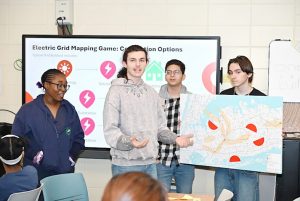
The workshop culminated in an “Electric Grid Mapping Simulation,” where students worked in groups to design their own power grid using a large map of New York City. They had to connect energy sources to communities while navigating real-world challenges such as congestion, environmental concerns and infrastructure limitations.
The activity brought classroom concepts to life, allowing students to experience the complexity of planning energy systems.
“I feel like this project was very good … I haven’t done things like this before,” said junior Sebastian Perpepaj. “This hands-on experience that actually helped me learn more about what these people go through every single day.”
He said the simulation expanded his understanding of the field.
“Before this, I didn’t even know about transmission lines and things like that — substations, transformers,” Sebastian said. “But now, I feel like I’ve been given a ball of knowledge that I can evolve on.”
The session ended on a high note, with all student groups recognized as winners — a reflection of both their creativity and their ability to tackle real-world engineering challenges.
At Pennington School, meanwhile, every student received their own robot kit to build at home, thanks to efforts and fundraising by the PTA.
Additionally, students participated in several experiments throughout the day, such as the classic fruit battery demonstration, where students transformed chemical energy into electrical energy using everyday items such as copper and citrus fruit.
“I know that was very important to our PTA president (MJ Silkowski), who did a fantastic job coordinating this day,” said fifth-grade teacher Rachel Frederick. “She wanted every kid to go home with a robot that they could look at on their bedroom shelf and feel so proud of themselves, and maybe it would inspire them to do something else in the future.”
Students were also treated to a special assembly from students and staff at STEAM Academy. Third-, fourth- and fifth-graders learned about artificial intelligence and how people utilize AI in STEM-related jobs. This presentation was spearheaded by Nedra Stewart, a biology teacher at STEAM Academy.
Upper grades learned about chemistry through live demonstrations from STEAM Academy seniors Emely La Paz, Miriam Mullings, Rozelle Brewster and Anisah Khan, facilitated by Steven Glinias, who teaches AP Chemistry, Chemistry and Project Lead The Way Principles of Biomedical Science.
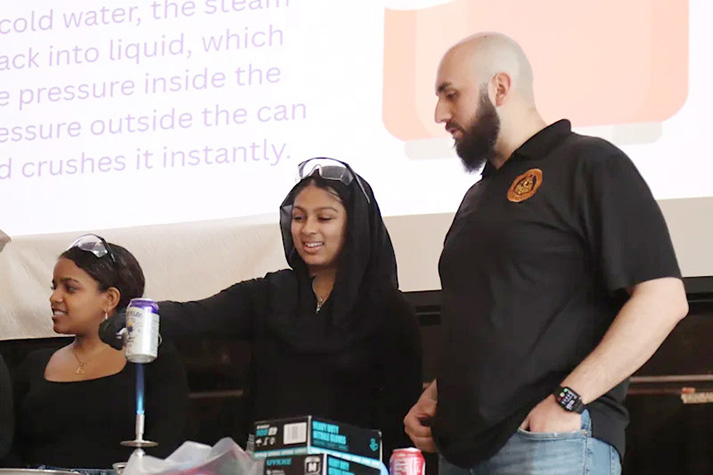
Pennington students explored scientific concepts such as pressure by heating a soda can, and different types of energy by using dry ice to inflate a balloon.
“Engineering and science specifically is so great for cultivating not only skills, but wonder and curiosity, especially in this generation where access to information is right at our fingertips,” Ms. Frederick said.
By blending career exploration with hands-on learning, the NYPA presentation gave STEAM Academy students a clearer picture of how energy powers their lives — and how they could one day power the future.
And at Pennington, that same spirit of curiosity and discovery ensured that every student walked away not just with a project in hand, but with a spark of inspiration for what they might build next.