MOUNT VERNON – Thirty-eight Mount Vernon City School District lunch monitors returned to school recnelty with an important new set of skills: the ability to respond when a child or adult faces a potentially life-threatening emergency.
The monitors, along with two Central Office staff members, were trained in cardiopulmonary resuscitation, first aid and the use of an automated external defibrillator during the District’s first Superintendent’s Conference Day of the 2026-27 school year.
The training by the American Red Cross in the Education Center Conference Room was conducted the day before the first day of school so that the 38 lunch monitors – who represent more than half of the District’s 71 monitors – would be prepared across all 13 school buildings.

For some, the training served as a refresher and recertification of skills they already possessed. For others, it marked the first time they had received formal certification in potentially lifesaving emergency response techniques.
The training is particularly important because lunch monitors are responsible for the approximately 6,400 students during one of the most active portions of the school day.
In the District’s pre-K through seventh- and eighth-grade buildings, monitors take over supervision of classes during teachers’ duty-free lunch periods. They escort students from classrooms to cafeterias, supervise them while they eat, accompany them outside for recess and oversee both structured and unstructured play.
That period can also bring situations requiring immediate attention, ranging from playground injuries to medical emergencies involving choking, allergic reactions, asthma or other respiratory distress.
The training was designed to prepare monitors to respond during those critical first moments before additional medical assistance arrives.
Participants learned how to recognize when a child or adult is unresponsive and activate the emergency response system. They practiced chest compressions and rescue breaths for adults, children and infants, and learned how to respond to choking in conscious and unconscious victims.
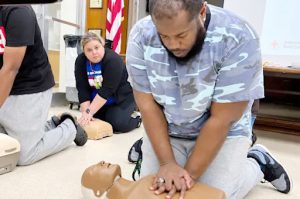
They also received instruction in retrieving and operating an AED, including the placement of pediatric pads.
First aid instruction covered controlling severe bleeding and stabilizing suspected fractures and head and neck injuries. Participants were also trained to recognize signs of anaphylaxis, asthma, seizures and shock, and to respond appropriately while awaiting additional assistance.
Another component focused on communicating effectively with school nurses and emergency medical personnel so that responders arriving at the scene receive useful information about what occurred and what treatment has already been rendered.
Holding three separate sessions allowed the groups to remain small enough for each participant to be individually tested on the skills taught during the course.
The certification remains valid for two years, establishing a recertification cycle that the District’s Food Services Department will track.
The initiative also expands the number of trained responders available throughout the District. Lunch monitors are frequently stationed in cafeterias, on playgrounds and on blacktops, putting them in locations where injuries or medical emergencies may occur.
Having additional employees trained in CPR, first aid and AED use also provides support for school nurses and strengthens the emergency response capacity outlined in each school’s building-level safety plan.
The training supports the District’s wellness policy and its compliance with New York State requirements regarding the availability of AEDs and staff trained in their use.
Local 338 RWDSU/UFCW representative Yolanda Santoni visited the Education Center during the sessions to offer encouragement and thank monitors for participating.
Clifton Abney, a Local 338 shop steward and school lunch monitor at the Rebecca Turner Academy, participated in the training alongside his colleagues and thanked fellow monitors for taking part.
Director of Food Services Donna Jackson said providing monitors with the training is closely connected to the department’s broader responsibility for the well-being of students.
“In my second year as Director of School Food Services, coordinating and training our school lunch monitors matters to me because they stand on the front line with this community’s most precious assets: our children,” Ms. Jackson said.
“Breakfast, lunch and recess are where our children learn what it looks like to be healthy and fit, and the monitors are our ambassadors of wellness in those moments,” she said. “Training them is not separate from the success of the food service program; it is integral to the success of the food service program.”