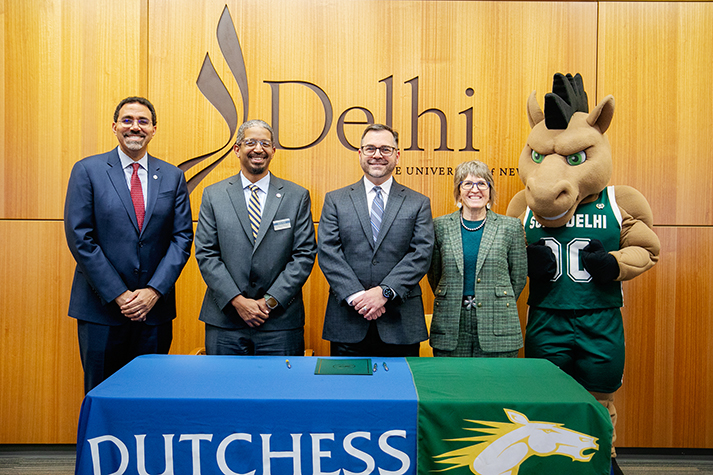
POUGHKEEPSIE – Dutchess Community College (DCC) and the State University of New York College of Technology at Delhi (SUNY Delhi) agreed to streamline admission for DCC graduates with an Associate in Applied Science (AAS) in Electrical Technology into SUNY Delhi’s Bachelor of Technology (BT) in Mechatronics Technology program. The agreement was formalized during a signing ceremony and announcement to build a new $32 million applied technology facility at SUNY Delhi, expected to open in 2030.
This newest articulation agreement expands the more than 80 established pathways that help DCC graduates transfer seamlessly into bachelor’s degree programs at SUNY, City University of New York (CUNY) and private colleges across New York and beyond. To qualify for admission into SUNY Delhi’s BT program via this pathway, students must have earned their AAS in Electrical Technology, or a closely related program, at DCC and hold a minimum cumulative grade point average of 2.0.
“Dutchess Community College is thrilled to enter into an agreement with SUNY Delhi to streamline transfer for our Electrical Technology students who wish to pursue their bachelor’s in Mechatronics Technology,” said Raymond Houston, DCC’s vice president for instruction and learning. “Opportunities like this ensure our students can commit to their studies with confidence, knowing that they will have strong support and academic continuity during their time at both institutions. We thank SUNY Delhi for their partnership and shared commitment to the success of our students and the vitality of our communities.”
“As one of the leading institutions in advanced manufacturing education in New York State, SUNY Delhi is proud to partner with Dutchess Community College to connect these future-focused degrees in ways that expand opportunity for students across the state and strengthen regional workforce development,” said SUNY Delhi Provost Dr. David Brower. “By working together and linking complementary degrees across the SUNY system, we are addressing critical industry demand for highly skilled manufacturing professionals, supporting economic growth, and preparing graduates to be leaders in the industry.”