By Jennifer L. Warren
NEW WINDSOR – In the winter of 1782-1783, the New Windsor Cantonment was a major hub, consisting of 7000 soldiers-along with family members of 500 women and children- all representing a wide range of backgrounds, hailing from six states, making the site the second largest population center in New York of its time.
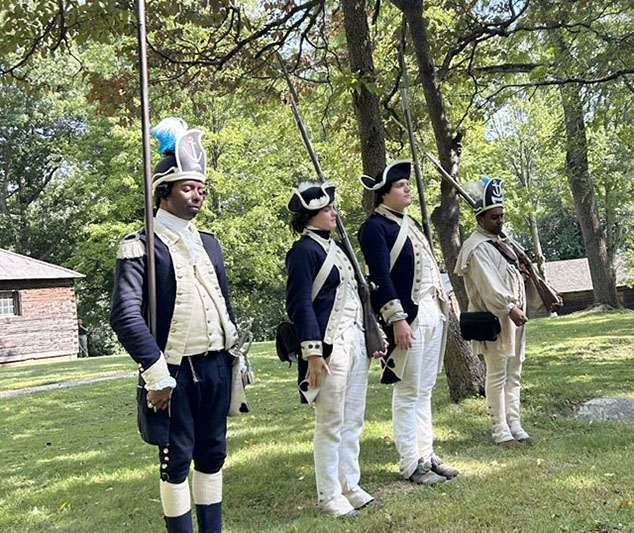
One of those pivotal units was The Rhode Island Line. Stationed at the Encampment for a few days, they were entrusted with the hefty task of replacing the New Hampshire Line guarding the northern part of the state. Many people familiar with the Revolutionary War are familiar with the valiant efforts of this regiment; however, few are versed in its inclusion of African and Indigenous peoples as well as the reputable breadth of their contributions, facts not often discussed in the classroom or other places. For those reasons-along with a host of others- the New Windsor Cantonment and Knox’s Headquarters State Historic Site held a special program Saturday titled: The First Rhode Island Regiment: the African and Indigenous Contributions to the Continental Army’s “Black Regiment.”
“Through providing multiple perspective programs like this one, we seek to share the under told stories of people and provide a deeper look into our state history,” said Chad Johnson, Historic Site Manager at the Cantonment about the purpose of the six hour, multifaceted event.
That free living history, family-friendly venue included an eclectic mix of offerings, allowing guests to learn this critical, elusive and important part of Revolutionary War history in a variety of ways. Because the Rhode Island Regiment provided freedom to enslaved men in exchange for military service it made them one of the most diversified in the entire Continental Army. That “Black Regiment” spanned; Black, Indigenous as well as white soldiers. History interpreters from the 1st Rhode Island Regiment could be spotted on the Cantonment’s lawn sharing the soldiers’ unique narratives as well as undeniable impact on American freedom.
“People are really happy to learn pieces of history they might not have gotten in school,” said one of those interpreters, Antoine Watts, clad in the authentic, traditional Revolutionary War military garb of a long, navy blue coat and pants along with white shirt and vest, topped off with a high arched, feathered hat. “Our goal is to hit all 13 colonies-states by 2033, educating people.”
Watts, during his more formal talk, also provided some intriguing background and critical, service information on members in his unit.
Guests learned about The Slave Enlistment Act of 1778’s passage but also how many in the slave owning class were vehemently against slaves joining the military, doing all they could to stop their recruiting; only 150 were enlisted in the 1st Rhode Island Regiment when the Act was repealed. Watts further relayed the Unit’s contributions at the Battle of Springfield, its participation in the Siege of Yorktown as well as other, often covert yet catalytic feats. Sadly, despite the Black Regiments’ extensive contributions, there were many disappointments.
“Half of the men promised freedom did not ever get there,” Watts said. “Some promises were kept, but many were not.”
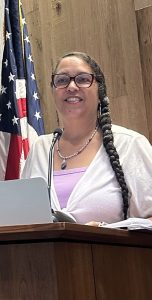
Also giving a talk, “Revolution, Impact, Diplomacy and Sovereignty” indoors was Loren M. Spears, who related intricate details about the experiences of Narragansett people, unfreedom, sovereignty and the unde- the- radar story of the Indigenous service in the 1st Rhode Island Regiment during the Revolutionary War. Relating a bevy of precursors to war-such as greed, power, entitlement, fear, hate and forced assimilation, Spears pointed out, “The indigenous peoples had the highest number per capita of service.” She continued, “There is no history without the Rhode Island Indigenous history,” stressed Spears, who also alluded to the harmful effects of such propaganda phrases as: ‘Merciless Indian Savages.’ “A lot of time when we tell stories of war, we leave out the Indigenous peoples.”
Spears went on to point out that of the official register of 225 people serving in the 1st Rhode Island Regiment, about 75 were Indigenous, “That’s one-third of the Regiment,” she emphasized, adding the litany of reasons for this service, including; Brotherhood, survival , freedom, “and the number one reason: to protect their own.”
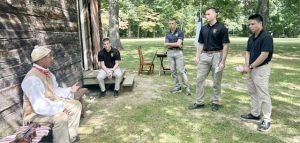
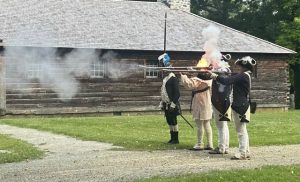
Following the lecture, back outside, more living history unraveled as military drills, including the lively, step-by-step-detailed firing off of three muskets with ensuing marching. Guests were also treated to tabletop displays; one laden with transformative, women’s work war contributions: cooking, laundry and nursing. Whether it was Hannah Till: the personal Chef to George Washington, Polly Cooper: the Native American who helped Washington’s troops at Valley Forge or Margaret Thomas: the freed Black woman laundress to George Washington, visitors were able to see-up-close-and-personal- items-Epsom Salt, Fennel Seeds, Chamomile, corn, beans, potatoes and bread these trailblazer women used. Nearby, was a blanket filled with paraphernalia connected to members of the 1st Rhode Island Regiment: books, rucksack bags, and coffee mugs.
“When you look at history always ask yourself something,” said Loren. “Who is being included, and who is being left out.”