By Dwight Brown
NNPA Film Critic
(***½)
He’s punching above his weight class. Hollywood bets against him, but they shouldn’t.
That’s how writer-actor Sylvester Stallone got his classic movie Rocky made. It’s a feat that must have impressed director Peter Farrelly (Green Book) and his creative team, who now retell the journey behind that iconic film. If they’ve done it the right way, they’ve got a crowd-pleaser. If they’ve done it the wrong way, they’ve got a tacky melodrama on their hands.
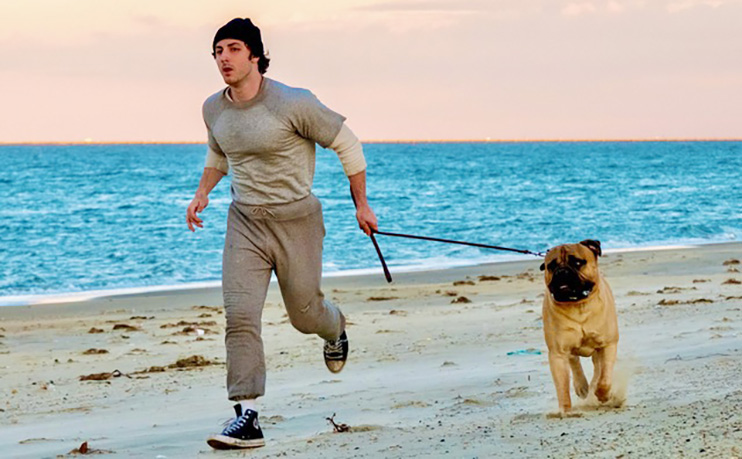
The story begins in New York City, where the fledgling actor (Anthony Ippolito) can’t land a role that pays a living wage. Eventually, he finds work in porn films. The money helps, but it’s just a bridge to something bigger. Few believe in him except his dog, Butkus, a bullmastiff, and his new girlfriend, Sasha (AnnaSophia Robb). She becomes his positive life force, telling him, “I’d rather be an opportunist and be wrong.” Those humble beginnings make Stallone immediately relatable to audiences familiar with Rocky and those discovering his story for the first time.
After the couple and pup pack up and move to L.A., little changes. Their grappling continues until Stallone, now a car valet, shows some of his scripts to famed producers Irwin Winkler (P.J. Byrne) and Robert Chartoff (Toby Kebbell). A screenplay about a boxer catches their eye. At first, that bit of fortune appears life-changing. In reality, it’s only the beginning of another onslaught of aggravation, indignities and struggles to realize potential.
Peter Gamble’s script unfolds in three clear acts: Stallone’s suffering in New York, his hardships pitching projects in Los Angeles and, finally, the making of the highest-grossing film of 1976. But every step forward seems to bring another setback. Viewers ride an engaging emotional roller coaster, moving from sorrow to happiness, love to anger and satisfaction to disappointment. It’s as if the world is against the young man and his dreams, and the Hollywood machine is the biggest hurdle he’s ever faced. David looks up at Goliath; Goliath stares down at David. The battle is on!
The trials and frustrations the emerging actor-writer experiences while trying to get a project made in the ‘70s remain relevant today. It’s the kind of inner and outer battle audiences love—especially if the protagonist has a chance to succeed. Thus, the monumental ending becomes one fans of the OG film will remember kindly and newcomers will appreciate for the first time.
All the magic of the Oscar-winning Best Picture Rocky is here. Brick by brick, editor Sam Seig builds the footage into an increasingly compelling portrait. When Stallone’s spirits rise or fall, Dave Palmer’s score appropriately underscores his emotions. Sleeping in alleys, tense Hollywood negotiations and sparring in boxing rings feel immediate because Anthony Gasparro’s production design anchors each setting. All of it is captured through Sean Porter’s perceptive cinematography, which faithfully evokes New York’s grimy streets, Los Angeles’ sunny skies and Philadelphia’s urban spirit.
Farrelly masterfully balances comedy, romance, drama and moments of bravura without disturbing the film’s equilibrium. Expect viewers to break into applause during this film, whether they’re in a theater or at home on the couch. That’s the kind of reaction a film can inspire when its characters fight like hell for what they want. It’s a spirit that holds the entire film together for two hours and eight minutes. And in the process, Sylvester Stallone, now a media darling, isn’t portrayed as a cartoon image of himself. His on-screen character never loses his self-respect despite the humbling—sometimes embarrassing—situations he encounters.
Ippolito catches Stallone’s nuances—his speech patterns, distinctive voice and physical mannerisms. He looks, talks and walks like the real man. All hope rests on this actor’s shoulders and his ability to bring the young Stallone to life, without it turning into an imitation, and he handles the challenge impressively. Robb, as Sasha, his supportive girlfriend and future wife, is the voice of reason and hope. Stephan James plays a charming Carl Weathers, making it feel as if he and Stallone have stumbled into a stroke of good fortune bigger than either one of them.
Tracy Letts plays studio head Sandy Maddox, a fictional composite character who wants the milk but not the cow, and badgers Stallone endlessly. That makes him the adversary viewers will want to strangle. The character benefits from a compelling screenplay, a distinct personality and an actor who knows how to turn the villainy up to a fever pitch. Add Matt Dillon as the father with the sensitivity of a tree, and the ensemble cast becomes strong enough to go the distance in a 15-round match.
By the time the film gets deep into its final chapter, audiences are captivated by the recreation of the iconic scenes from Rocky. Visions of the boxer running through the streets of Philadelphia, punching hunks of meat in a freezer and getting bludgeoned during fierce battles evoke the excitement of the original. But that indelible image of Rocky running up the steps of the Museum of Art and raising his fists to the heavens takes fans of the film to a state of nirvana. Learning how all those famous moments were created is almost as stirring as watching Stallone struggle to bring his signature movie to life.
It’s easy to root for this underdog pugilist in an inspiring biographical drama that wins by a TKO.