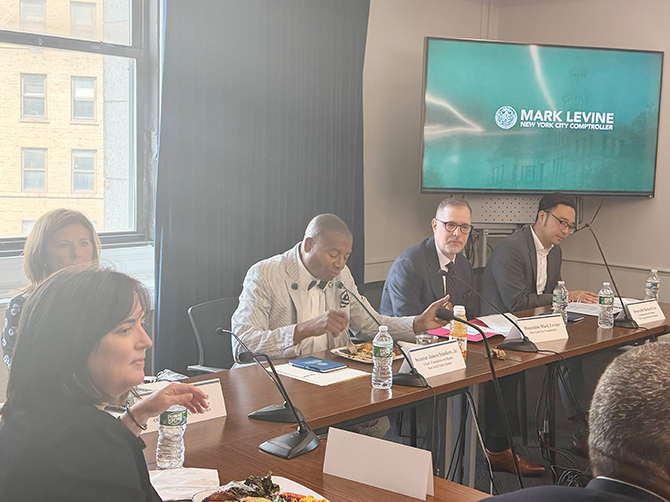
New York State Senator James Sanders Jr. on August 12th hosted a luncheon roundtable, “Strengthening Minority Banks: Expanding Access to City and State Capital,” bringing together government officials, financial leaders and representatives of minority depository institutions to discuss concrete ways New York can strengthen minority-owned and community-based banks.
The roundtable, held at the New York City Comptroller’s Office at One Centre Street in Manhattan, included representatives from the Federal Reserve Bank of New York, New York City Comptroller Mark Levine, New York City Commissioner of Finance, Richard Lee, representatives from the New York State Comptroller’s office, along with representatives from the banking and financial sectors and other stakeholders.
The discussion focused on strengthening partnerships between government and minority depository institutions and identifying ways to increase the ability of these institutions to access and manage City and State deposits and capital.
“Minority banks have historically served communities that larger financial institutions have too often overlooked,” said Senator Sanders. “If we are serious about closing the racial wealth gap and creating economic opportunity, government must do more than talk about inclusion. We must examine where public dollars are deposited, who benefits from those dollars and how we can use the tremendous purchasing and financial power of government to strengthen institutions that reinvest in our communities.”
Sanders emphasized that placing more public funds with qualified minority depository institutions can have an impact far beyond the banks themselves. Stronger community banks can increase their capacity to provide financing to small businesses, homeowners, entrepreneurs and historically underserved neighborhoods.
The roundtable provided participants with an opportunity to speak directly about the challenges facing minority depository institutions and the steps government and financial leaders can take to create stronger partnerships.
“We brought the people who control and understand public capital into the same room with the institutions that are working every day in underserved communities,” Sanders said. “The goal is to move beyond conversation toward action. When minority banks become stronger, they are better positioned to lend to our businesses, invest in our neighborhoods and help families build wealth.”
Sanders has made strengthening minority financial institutions and expanding access to capital a major part of his economic development agenda. The Senator has advocated for greater participation by minority-owned banks in government banking relationships and for policies that ensure public dollars can help generate economic activity in communities that have historically lacked access to capital.
The event reflected a shared recognition that government, financial institutions and community stakeholders must work collaboratively to address longstanding disparities in access to banking and investment.
Senator Sanders thanked Comptroller DiNapoli’s office, Comptroller Levine, Commissioner Lee, the participating financial institutions, and stakeholders for joining the discussion. He also acknowledged Industrial Bank, which provided lunch and refreshments for the roundtable.
“This meeting is not the finish line,” Sanders added. “It is part of a larger effort to change how government uses its financial power. We want our public dollars working for all New Yorkers, including the communities that have historically received the least investment. Strengthening minority banks is one important way to make that happen.”